Deadline: 15 December 2026 · Country: Europe · Study level: Master’s · Funding: Fully funded
NOHA Erasmus Mundus Scholarship 2027–2029
Country: Europe (France, Malta, Netherlands, Germany, Spain, Ireland, Poland, Sweden)
Universities: 8 NOHA universities, coordinated by the University of Deusto (Spain)
Official page: nohanet.org — NOHA Master’s
Funding type: Fully funded (Erasmus Mundus)
Study level: Master’s (2 years, 120 ECTS)
Deadline: 15 December 2026, 23:59 GMT
RB Scholar presents the NOHA Erasmus Mundus Scholarship 2027–2029. It is a fully funded two-year Master’s scholarship in International Humanitarian Action in Europe. Winners receive €1,400 per month for up to 24 months and pay no tuition fees. Citizens of Tajikistan can apply. The scholarship deadline is 15 December 2026, 23:59 GMT, which is 04:59 on 16 December in Dushanbe.
NOHA (Network on Humanitarian Action) is a group of European universities that created the first Master’s degree in humanitarian studies in 1993, with the support of the European Commission. More than 3,500 graduates now work in humanitarian aid and international cooperation. The programme was selected again for EU funding and will offer Erasmus Mundus scholarships for four more intakes. For 2027–2029 there are 16 scholarships.
You study in at least two countries: the first semester at your home university, the second at another NOHA university, then a regional training at a partner university or a work placement, and finally your thesis. Read this guide step by step: we explain the eligibility, documents and application process specifically for students from Tajikistan.
Why choose the NOHA scholarship:
€1,400 per month for up to 24 months (up to €33,600 in total)
No tuition fees and no application fee
Study in at least two European countries
Work placement with a humanitarian organisation, or a semester in Jordan, India, Thailand, the USA and other countries
Six of the eight universities teach the first two semesters fully in English
No age limit is stated
Insurance is included for the whole study period
Programme and specialisations (2027–2029)
There is one programme: the Erasmus Mundus Joint Master’s Degree in International Humanitarian Action (120 ECTS). It starts with a joint Intensive Programme at the beginning of September.
Universities that teach in English
You can study here with English only. The specialisation is what the university offers in the 2nd semester:
Ruhr University Bochum (Germany): Humanitarian Policy and Practice
University College Dublin (Ireland): Resilience, localising the aid effort
University of Groningen (Netherlands): Humanitarian Analysis and Intervention Design
University of Malta: Forced Migration and Human Security
Uppsala University (Sweden): Conflict, Peace-building and Religion
University of Warsaw (Poland): Armed Conflicts and Humanitarian Action
Universities that need another language
University of Deusto (Spain): Protection in Humanitarian Action. 1st semester in Spanish (B2), 2nd semester in English
Aix-Marseille University (France): Legal and Geopolitical Approach of Humanitarian Action. Both semesters in French (C1)
How the two years work
1st semester (September–January), home university: world politics, law, public health, management, people and culture
2nd semester (February–June), host university: your specialisation
3rd semester (July–January): a regional training at a partner university (Jordan, Lebanon, Qatar, India, Thailand, Indonesia, Australia, Sierra Leone, Colombia, Guatemala, USA) or a work placement
4th semester (February–June), home university: research and the Master’s thesis
All details are on the official NOHA page.
Financial coverage
The NOHA Erasmus Mundus Scholarship 2027–2029 includes:
€1,400 per month for up to 24 months, the same amount for every nationality
No tuition fees: under EU rules, Erasmus Mundus scholarship holders are not charged tuition or other mandatory course costs (self-funded students pay €4,000 per semester)
Insurance for the whole study period
Library, laboratory, exam and diploma costs
How many scholarships are there?
8 scholarships for Partner Countries. Tajikistan competes here.
4 scholarships for Programme Countries (EU and associated countries)
4 extra scholarships for targeted regions 1, 3, 5, 7, 8, 9, 10 and 11. Tajikistan is in Region 6, Central Asia, so these four are not for Tajik applicants.
One nationality can receive no more than 10% of all scholarships, so in practice about one student per country.
Good to know: travel, visa, installation, rent and food are paid from your €1,400. The scholarship is only awarded in full and only to full-time students. It can’t be combined with another EU-funded scholarship for the same course, and it can be reduced if you don’t complete the mobility.
Eligibility criteria (for students from Tajikistan)
Good news: citizens of Tajikistan can apply. Tajikistan is an Erasmus+ Partner Country.
For the scholarship
A completed bachelor’s degree (at least 180 ECTS; a four-year bachelor’s degree is normally 240 ECTS)
You must have finished your degree by 15 December 2026. Final-year students can’t get the scholarship this year.
A field related to humanitarian action: medicine, food sciences, economics and management, engineering, law, social sciences, education or humanities
You have never received an Erasmus Mundus (EMJM/EMJMD) scholarship before
You study in at least two countries that are different from your country of residence. If you live in Tajikistan, this is easy to meet.
English (C1), one of these
IELTS: overall 6.5, no section below 6.0
TOEFL iBT: overall 5, writing 5, other sections at least 4.5 (the new TOEFL scale)
Cambridge CAE (C1) or CPE (C2)
Home versions of IELTS and TOEFL are not accepted
No test is needed if your whole bachelor’s degree was taught in English and your diploma, transcript or an official university letter says so
Other languages
French C1: only for Aix-Marseille
Spanish B2: only for the 1st semester at Deusto. Without a certificate, Deusto holds an interview.
How candidates are chosen
The committee looks at your education, research, professional experience (including NGOs and volunteering in humanitarian work), motivation, languages, recommendations, an interview if there is one, and the balance of nationality and gender. NOHA says competition is very high: successful candidates usually have excellent grades and humanitarian experience.
Important: an Erasmus Mundus application that is incomplete or in the wrong format is ineligible. Nothing can be added after the deadline.
Required documents
Upload to the online form (PDF or JPG, up to 2 MB each)
International passport: the main page only
Bachelor’s diploma: a scan of the original plus an official translation into English (translation agency and notary). Add the Diploma Supplement if you have one.
Transcript: the diploma insert with grades, or an official transcript from the dean’s office (деканат) with signature and stamp. Attach the original and the English translation.
CV in English, in Europass format. Show humanitarian, volunteer and NGO experience clearly.
Language certificate: IELTS, TOEFL iBT or Cambridge. If you have several certificates, merge them into one file.
Two reference letters in English: signed, dated, not older than 2 years, on letterhead with a stamp if possible. One academic and one professional is best. Relatives can’t write them.
Proof of residence issued within 12 months before 15 December 2026 (see below)
Master’s diploma, publications and other certificates, if you have them
Proof of residence: how to get it in Tajikistan
NOHA does not accept a passport, ID card or utility bill. A municipality certificate is accepted only in Dutch, English, French, German, Maltese, Polish, Spanish or Swedish. So the easiest options for Tajikistan are:
A certificate from your workplace or university in English, with your address, signature and stamp (or with a certified English translation)
A notary document in English that confirms where you live
You write these in the form
Motivation statement: up to 3,000 characters. NOHA asks you not to use AI.
Abstract: up to 500 characters (name, age, nationality, degree, motivation, experience)
Special circumstances: up to 2,000 characters, if any
Also prepare (national requirements)
Deusto: a legalised or apostilled diploma, with a certified translation, and a document confirming that your diploma gives access to Master’s studies
Warsaw: a diploma with the full list of grades and an official document stating that it gives the right to Master’s study in Tajikistan
Groningen: proof of funds (about €14,160 for home students, €5,900 for host students, refundable) or a scholarship letter, plus a €254 visa fee
Check the full list of national requirements before you rank the universities
Application process:
NOHA with the Erasmus Mundus scholarship: step by step
Step 1. Check that you already have your bachelor’s degree and an accepted English certificate. If you have no certificate, book the nearest test date so that the result arrives before 15 December.
Step 2. Choose your universities. You rank 8 choices for the home university (1st semester) and 8 for the host university (2nd semester). Put the English-taught universities first if you don’t speak French or Spanish.
Step 3. Ask for two reference letters and the proof of residence early. These take the most time.
Step 4. Translate your diploma and transcript into English and certify them with a notary.
Step 5. Open the NOHA application form and choose “Apply with the Erasmus Mundus grant”.
Step 6. Fill in all the sections: personal data, education, work, languages, referees, motivation and abstract.
Step 7. Upload the documents (PDF or JPG, up to 2 MB each) and submit before 15 December 2026, 23:59 GMT. You should get a confirmation on the screen and by email.
Step 8. At the beginning of January 2027 ineligible candidates are informed. They have 7 days to appeal, but can’t add new documents.
Step 9. The results arrive by email in March 2027: selected, reserve list or not selected. If you aren’t selected, you can continue as a self-funded candidate.
Step 10. If you win, apply for a student visa of your home university’s country. Check early which embassy serves Tajikistan, because not every country has one in Dushanbe. Studies start in September 2027.
Don’t: send paper documents, use AI for the motivation statement, upload a passport as proof of residence or wait for the last night. Questions go to nohamasters@deusto.es.
NOHA scholarship 2027–2029 deadline:
Applications opened: 1 October 2026
Erasmus Mundus scholarship: 15 December 2026, 23:59 GMT (04:59 on 16 December in Dushanbe)
Notice to ineligible candidates: beginning of January 2027
Scholarship results: March 2027
Self-funded applications: 1 April 2027. NOHA also lists 1 July 2027 for applicants without EU citizenship or an EU residence permit; ask your first-choice university which date applies to you.
Results for self-funded students: July 2027
Start of studies: September 2027
Can’t make this deadline? Scholarships will be offered for further intakes; this call opened on 1 October, so watch for the next one in autumn 2027. Also look at the Eiffel Scholarship in France and all fully funded scholarships.
Increase your chances of admission with our professional services.
NOHA scholarship: frequently asked questions
Can students from Tajikistan apply for the NOHA Erasmus Mundus Scholarship?
Yes. Tajikistan is an Erasmus+ Partner Country, so Tajik citizens compete for the 8 scholarships for Partner Countries. The 4 scholarships for targeted regions don’t include Central Asia.
What is the NOHA scholarship deadline for 2027–2029?
The Erasmus Mundus scholarship deadline is 15 December 2026, 23:59 GMT. Self-funded applicants can apply until 1 April 2027.
How much does the NOHA scholarship pay?
€1,400 per month for up to 24 months, up to €33,600 in total. Scholarship holders pay no tuition fees, but cover travel, visa and living costs from this money.
What IELTS score do I need for NOHA?
IELTS 6.5 overall with no section below 6.0. The home version of the test isn’t accepted.
Can I apply in the final year of my bachelor’s degree?
Not for the scholarship: you must complete your degree by 15 December 2026. Final-year students can ask the universities about self-funded admission or apply in the next call.
Can I send my IELTS certificate after the deadline?
No, not if you apply for the scholarship. All documents must be uploaded by 15 December 2026. Only self-funded applicants can send their scores later.
Is there an application fee?
No. EU rules don’t allow Erasmus Mundus programmes to charge an application fee.
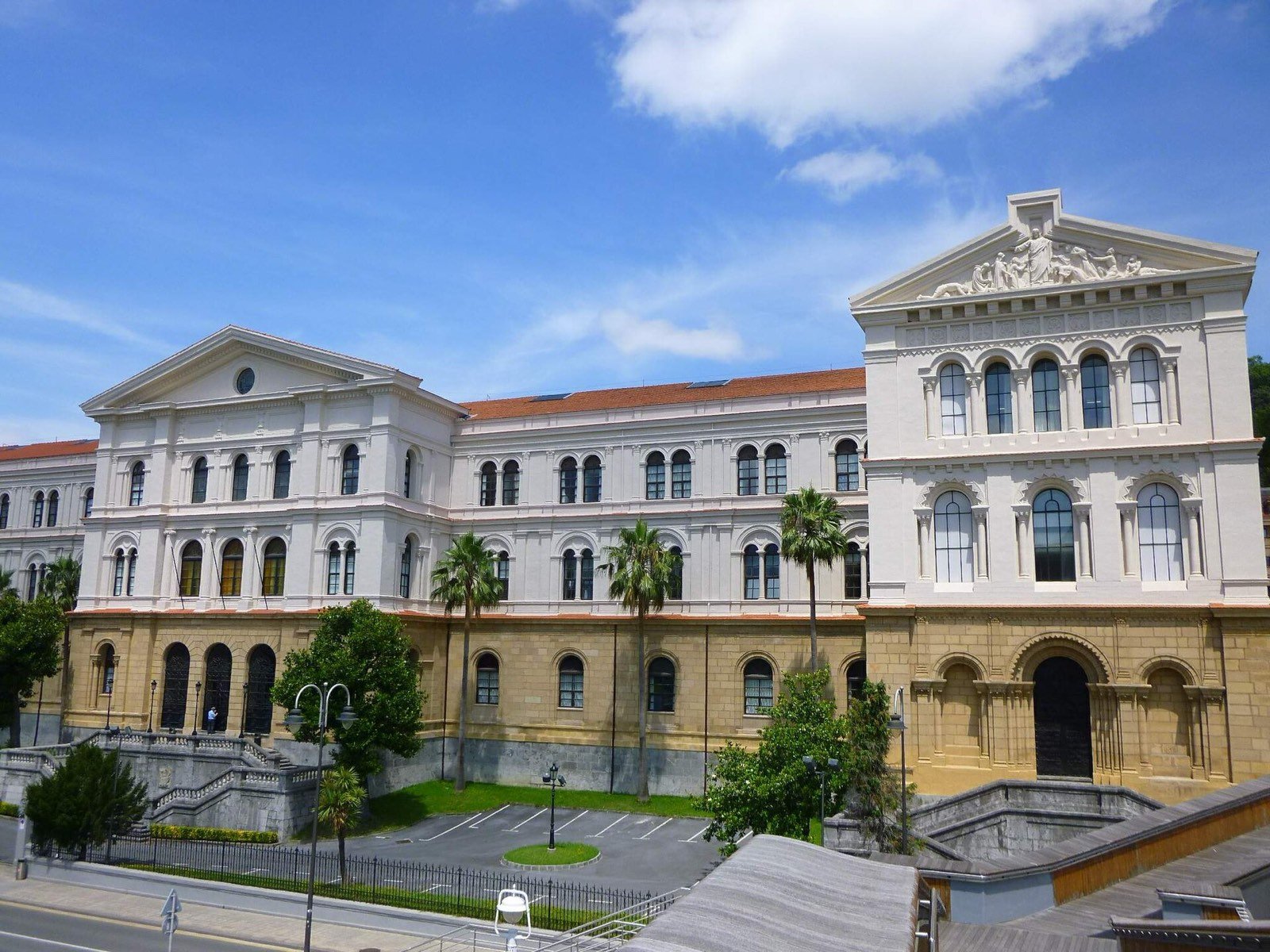
Photo: University of Deusto, Bilbao — Zarateman, Wikimedia Commons, CC BY-SA 4.0.
Нужна помощь с заявкой?
Информация на сайте бесплатна. Если хотите, наша команда подготовит и заполнит заявку вместе с вами — это платная профессиональная услуга.